the mommunist philosophy
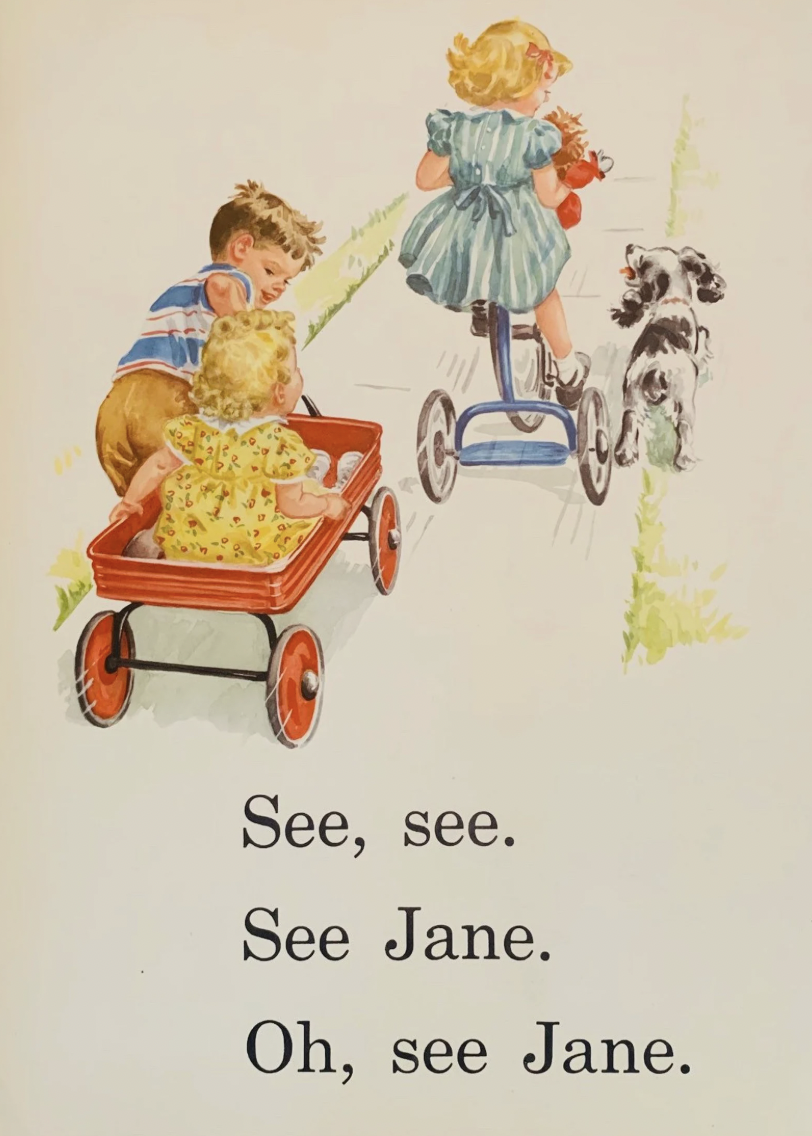
The Premise: Dick & JANE
Let's talk about Dick.
Not the man — the symbol. Dick stands in for the millions of men, across generations, who built and maintain the patriarchal structure we all live inside.
Dick builds a house. Dick marries Jane in the name of "love and lineage." Jane manages domestic life, affording Dick the opportunity to work, earn, and rise. Jane wakes up one day wanting more — a job, some money of her own.
Enter white feminism. Jane fights her way to CEO — while still living inside Dick's house. She's celebrated as a woman who "made it." But behind her, propping her up, are the lower-income women whose labor made Jane's rise possible. Just like Jane's labor made Dick's rise possible.
Mommunism challenges the notion that Jane could ever achieve equality in Dick's house. Because as Audre Lorde wrote, the master's tools will never dismantle the master's house. Similarly, the mommunist movement posits that we cannot achieve gender equality by playing in a structure engineered for subordination. Jane doesn't need a corner office in Dick's house.
Jane needs to build her own house.
the proposal
Mommunism is the philosophy that women — and mothers specifically — build outside the patriarchal household rather than negotiate for better terms within it. Not assimilation into existing power structures, but the construction of new ones: shared homes, shared labor, shared childcare, shared resources. Built collectively. Built by choice. Built with other women.
We call it a mommune.
This is not a rejection of individual women who've succeeded inside existing systems — it's a recognition that individual success inside an unequal structure doesn't dismantle the structure. It just changes who's standing at the top of it, while the labor underneath stays exactly as unequal, and mostly still invisible.


Mommunism does not emerge from nothing. It stands on the shoulders of decades of feminist thought, and it names its debts openly:
Audre Lorde, Sister Outsider (1984) — the foundational argument that systems of oppression cannot be dismantled using the tools and logic of the systems themselves; the animating principle behind Mommunism's rejection of "winning" inside patriarchal structures.
bell hooks, Feminism Is for Everybody (2000) — the critique that mainstream feminism narrowed its aim to equality with men of one's own class, leaving the underlying hierarchy — and the women beneath it — untouched.
Silvia Federici, Wages Against Housework (1975) and Caliban and the Witch (2004) — the materialist analysis of unpaid domestic and reproductive labor as the invisible foundation of the household economy Dick's house depends on.
Kimberlé Crenshaw, "Demarginalizing the Intersection of Race and Sex" (1989) — the framework for understanding how gender, race, and class compound rather than operate independently, informing Mommunism's insistence that "Jane's" success cannot stand in for all women's liberation.
Sophie Lewis, Full Surrogacy Now (2019) and Abolish the Family (2022) — contemporary arguments for dismantling the nuclear household as the default unit of care and replacing it with distributed, collective kinship — closely adjacent to the mommune as a proposed structure.
The feminist communal-living tradition of the 1960s–70s (e.g., Twin Oaks and related intentional communities) — historical precedent for women organizing shared domestic and economic life outside the nuclear household.
Mommunism's contribution is not the discovery of these ideas, but their synthesis into a single, named framework — with its own vocabulary, its own allegory, and its own proposed structure.
— authored and developed by Bernie Sinclaire.